
21
Digital Rights
Digital Rights
Contenido
Young people are online every day, meaning they actively exercise their digital rights while also being vulnerable to their violation. In this playlist, you will learn how to support and protect young people in the digital world.
Digital youth work plays a crucial role in promoting respect for these rights and raising awareness of the associated risks. We will look at the ethical frameworks and practical steps you can take to create a safe digital environment for and with young people. This forms the basis for trust in online relationships.
Key Focus Areas in this Playlist:
- Viewing digital rights as an opportunity within youth work (C3.1).
- Awareness-raising on young people’s digital rights and their risks (C3.2).
- Supporting digital safety and resilience (C3.3).
About the Digital Competence Check
This playlist is directly linked to Competence Area 3 of the Digital Competence Check Digital rights, which is based on the European DYW SNAC Model. The Check covers 5 areas, 14 specific competences, and 38 indicators, helping you to map your starting proficiency level. By following this playlist, you will specifically target and improve the skills identified as areas for development.
This playlist features activities from the platform, all directly connected to this competence area. It is up to you to decide which activities are the most interesting and relevant for your professional development.
Within each activity, you will find four different badges. One badge is specifically intended for the Youth Worker. There are also badges for the Youth Worker's Manager and for Young People, should you wish to involve them in your development. This joint growth path is essential and is rooted in the Digital Systemic Team approach. Evidence shows that digital youth work is best realised when these four roles (Youth Worker, Manager, Young Person) collaborate.
Actividades a realizar
Complete las siguientes actividades, gane insignias y verá el progreso de su lista de reproducción actualizada
Good practice: Bringing Stories to Life: Augmented Reality in Youth Work
Opcional
Duración desconocida
Contenido
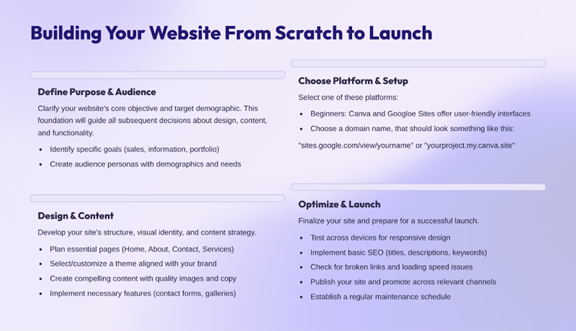
Esta actividad invita a trabajadores juveniles, organizaciones y jóvenes a crear un sitio web en conjunto: un espacio donde los jóvenes pueden expresar sus voces, compartir historias, mostrar ideas o arte, e interactuar con su comunidad en línea.
Elige una herramienta como Google Sites (https://sites.google.com) o Canva.com y codiseña un sitio que incluya voces juveniles: poemas, listas de reproducción, obras de arte, entrevistas, artículos de opinión o mini campañas.
Al completar esta actividad, podrás:
- Aprender a codiseñar un sitio web con jóvenes usando herramientas en línea gratuitas.
- Apoyar a los jóvenes en la expresión de su identidad, experiencias y creatividad en línea.
- Desarrollar la propiedad compartida y la ciudadanía digital a través de la narración colaborativa.
Inspírate.
Los jóvenes a menudo no se ven representados en línea; esta actividad les da un giro a la situación al brindarles las herramientas y el apoyo para crear su propio espacio. Visita el sitio web CurLoveCare.com (y Safeplace4.me cuando esté disponible) como ejemplo de un sitio web creado en colaboración con jóvenes de Curazao.
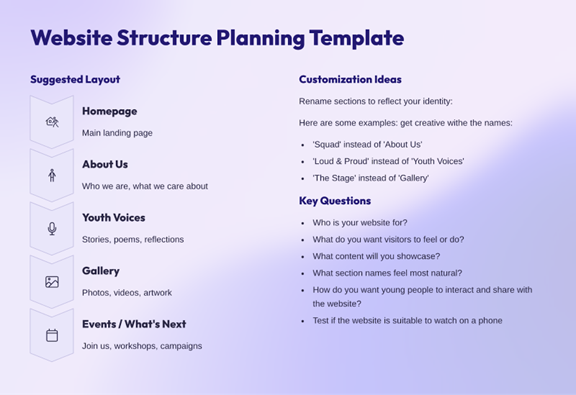
Piensa en una idea para un sitio web, eligiendo un tema relevante e interesante. Por ejemplo, puedes estructurar el sitio en torno a temas como "Lo que nos importa", "Voces de nuestra comunidad" o "Sueños para el futuro". Mantenlo simple, visual y auténtico.
Actúa: actividades para diferentes roles
Jóvenes:
- Decide qué quieres decir y a quién se lo quieres decir. Escribe, graba o dibuja algo que te importe.
- Ayuda a elegir la estructura y el diseño visual del sitio web: secciones, colores, diseño.
- Colabora para subir tu contenido y revísalo con tu grupo antes de publicarlo.
Trabajadores juveniles:
- Elige una herramienta web gratuita y accesible para tu grupo (Google Sites, Carrd u otra).
- Guía una sesión de planificación donde los jóvenes definan el tipo de sitio web que quieren crear: ¿qué propósito, tono y público?
- Apoya la coedición y la retroalimentación, a la vez que das espacio a los jóvenes para que lideren la creación de contenido.
Organizaciones juveniles:
- Explora cómo los sitios web creados por jóvenes podrían aparecer o integrarse en tu sitio web principal o en redes sociales.
- Anima al personal y a los voluntarios a usar estas herramientas en futuros talleres, campañas o proyectos comunitarios.
- Organice un evento de “Presentación de sitios web” en línea o en persona, donde los jóvenes presenten su trabajo y expliquen sus elecciones.
Actividades de seguimiento sugeridas
- Convierte el sitio web en un proyecto dinámico: actualízalo mensualmente con nuevo contenido o temas juveniles.
- Conecta tu sitio web juvenil con un taller de narración digital o alfabetización mediática.
- Imprime códigos QR para colocarlos en espacios públicos o escuelas y aumentar la visibilidad y el acceso al sitio juvenil.
Solicita el reconocimiento de la insignia abierta
Habilidades y experiencias adquiridas
- Creación digital colaborativa
- Voz juvenil y expresión cívica
- Creación y edición básica de sitios web
- Trabajo en equipo y comunicación
- Alfabetización mediática y publicación en línea
Quién creó este recurso?
Esta actividad fue desarrollada por CITI (Instituto de Innovación y Tecnología de Curazao), socio del proyecto Digital Systemic, como parte del proyecto Erasmus+ Desarrollo Sistémico del Trabajo Digital Juvenil, en colaboración con la Red de Ciudades del Aprendizaje.

Consigue la insignia de actividad
Cocreador del sitio web Consigue esta insignia
Se otorga a cualquier persona (joven, trabajador juvenil o socio) que contribuya a la planificación y la visión de un sitio web dirigido por jóvenes. Esta insignia reconoce tu papel al imaginar cómo un sitio web puede amplificar la voz de los jóvenes, fomentar la colaboración y generar un impacto real, incluso antes de su lanzamiento.
Tareas
Tarea no.1
Evidencia verificada por: Un organizador de actividades
Usando esta plantilla, planifica tu sitio web.
Tarea 2
Evidencia verificada por el organizador de la actividadComparte tu plan para el sitio web y cómo pretendes implementarlo: ¿Cómo dará voz digital a los jóvenes? ¿Qué colaboración se necesita para hacerlo realidad? ¿Qué impacto esperas que tenga el sitio?
Habilidades
#Good Level. Helps young people to understand the difference between facts, mis/dis-information, and, in general, to critically analyse information.
#Excellent Level. Supportes young people to improve their behaviours in looking for trustworthy sources or running their own online research.
#Excellent Level. Supports young people to develop counter-narratives to a case of fake news or disinformation.
#Excellent Level. Helps young people to critically analyse current communication challenges related to the information crisis and the use of synthetic media.
#Fair Level. Sensitise young people on situations when they are not fairly treated in the digitalised world.
#Good Level. Set with young people learning objectives on how to support their digital rights.
#Fair Level. Discusses with young people about the type of digital content they want to produce
#Good Level. Learns to integrate practice-based learning (non-formal learning) and youth participatory approaches in digital youth work practiceer personality.
#Excellent Level. Supports young people to assess their learnings after running their digital rights activities, and identify new ways of how to address them.
#Good Level. Understands digital youth work in a broad context of social effects and economic interests of digital transformation; applies solid ethical principles to both digital and traditional youth work.
#Excellent Level. Supports young people to assess their learnings after running their digital rights activities, and identify new ways of how to address them.
#Excellent Level. Supports young people and other youth workers to set goals for meaningful digital youth work, assess them and reflect jointly on the outcomes.
#Excellent Level. Supports young people to create their communities, based on pre-set learning objectives, while reflecting on the results.
#Fair Level. Askes young people to critically assess the practices of the youth work offering.
#Good Level. Sets with young people learning objectives for digital youth work.
#Excellent Level. Supports young people to assess their learnings after running their digital rights activities, and identify new ways of how to address them.
#Excellent Level. Supports young people and other youth workers to set goals for meaningful digital youth work, assess them and reflect jointly on the outcomes.
#Excellent Level. Empowers youth groups to use their critical thinking and imagination in order to discuss the ethical implications and find solutions to issues such as profiling, algorithmic filtering or algorithmic bias.
#Fair Level. Knows how to support young people to collectively, as a group, gather and reflect on online information (non-formal learning is social knowledge production).
ESCO
#develop a recycling program
ESCO
#checking recycling procedures
ESCO
#advising about pollution prevention
ETS-TR
#Consciously provides space for dialogue and interaction taking into account learners’ values and beliefs and offers space to reflect on them in the educational context
#Excellent Level. Creates different types of digital content and knows how to support others in similar processes (eg. podcasts; videos)
#Excellent Level. Empowers youth groups to use their critical thinking and imagination in order to discuss the ethical implications and find solutions to issues such as profiling, algorithmic filtering or algorithmic bias.
#Good Level. Knows how to organise educational and participatory activities connected to youth’s digital rights, and has been organised several with organisation.
#Good Level. Sets with young people learning objectives for digital youth work.
#Elementary Level. Uses basic digital tools and devices to run some digital youth work activities with young people, based on own intuition
#Excellent Level. Supports young people to create their communities, based on pre-set learning objectives, while reflecting on the results.
#Excellent Level. Supports young people to assess their learnings after running their digital rights activities, and identify new ways of how to address them.
#Excellent Level. Constantly assess, together with young people and/or other youth workers on the quality of the digital work and reflects what has been learned; as an intentional process part of the digital youth work strategy.
#Good Level. Plans and implements multiple digital youth work activities, using a diversity of digital tools
#Excellent Level. Shares practices, as a member of a network, which meets regularly and aims at developing digital youth work.
#Excellent Level. Supports young people and other youth workers to set goals for meaningful digital youth work, assess them and reflect jointly on the outcomes.
#Excellent Level. Supports young people and other youth workers to set goals for meaningful digital youth work, assess them and reflect jointly on the outcomes.
#Excellent Level. Empowers youth groups to use their critical thinking and imagination in order to discuss the ethical implications and find solutions to issues such as profiling, algorithmic filtering or algorithmic bias.
#Excellent Level. Supports young people to assess their learnings after running their digital rights activities, and identify new ways of how to address them.
#Excellent Level. Creates different types of digital content and knows how to support others in similar processes (eg. podcasts; videos)
#Good Level. Sets with young people learning objectives for digital youth work.
#Excellent Level. Supports young people to assess their learnings after running their digital rights activities, and identify new ways of how to address them.
#Excellent Level. Supports young people and other youth workers to set goals for meaningful digital youth work, assess them and reflect jointly on the outcomes.
#Excellent Level. Supports young people to create their communities, based on pre-set learning objectives, while reflecting on the results.
#Excellent Level. Empowers youth groups to use their critical thinking and imagination in order to discuss the ethical implications and find solutions to issues such as profiling, algorithmic filtering or algorithmic bias.
#Excellent Level. Engages young people on equal footing in the planning, running and evaluation of digital activities; they are an integral part of the strategic approach to digital transformation.
#Excellent Level. Supports young people and other youth workers to set goals for meaningful digital youth work, assess them and reflect jointly on the outcomes.
#Excellent Level. Shares practices, as a member of a network, which meets regularly and aims at developing digital youth work.
#Excellent Level. Empowers youth groups to use their critical thinking and imagination in order to discuss the ethical implications and find solutions to issues such as profiling, algorithmic filtering or algorithmic bias.
#Excellent Level. Supports young people to assess their learnings after running their digital rights activities, and identify new ways of how to address them.
#Excellent Level. Creates different types of digital content and knows how to support others in similar processes (eg. podcasts; videos)
#Excellent Level. Understands the benefits and risks of gaming and XR, knows how to deal with them and how to guide young people to ethical platforms; when needed, refers young people to specialised support in case of excessive/inappropriate use.
#Excellent Level. Supports young people to assess their learnings after running their digital rights activities, and identify new ways of how to address them.
#Excellent Level. Engages young people on equal footing in the planning, running and evaluation of digital activities; they are an integral part of the strategic approach to digital transformation.
#Good Level. Gathers a group of young people to engage in technological activities and agreed about their learning outcomes
#Good Level. Sets together with young people educational aims for their own digital content production
#Good Level. Sets with young people learning objectives for digital youth work.
#Excellent Level. Engages young people on equal footing in the planning, running and evaluation of digital activities; they are an integral part of the strategic approach to digital transformation.
#Excellent Level. Supports young people to create their communities, based on pre-set learning objectives, while reflecting on the results.
#Excellent Level. Supports young people to assess their learnings after running their digital rights activities, and identify new ways of how to address them.
#Excellent Level. Shares practices, as a member of a network, which meets regularly and aims at developing digital youth work.
#Excellent Level. Supports young people and other youth workers to set goals for meaningful digital youth work, assess them and reflect jointly on the outcomes.
#Excellent Level. Understands the benefits and risks of gaming and XR, knows how to deal with them and how to guide young people to ethical platforms; when needed, refers young people to specialised support in case of excessive/inappropriate use.
#Excellent Level. Creates different types of digital content and knows how to support others in similar processes (eg. podcasts; videos)
#Good Level. Gathers a group of young people to engage in technological activities and agreed about their learning outcomes
#Excellent Level. Understands the benefits and risks of gaming and XR, knows how to deal with them and how to guide young people to ethical platforms; when needed, refers young people to specialised support in case of excessive/inappropriate use.
#Excellent Level. Creates different types of digital content and knows how to support others in similar processes (eg. podcasts; videos)
#Excellent Level. Supports young people to assess their learnings after running their digital rights activities, and identify new ways of how to address them.
#Fair Level. Supports young people to learn social skills through participation in digital communities, such as discussion groups, life-style sites, vlogs or gaming.
#Good Level. Plans and implements multiple digital youth work activities, using a diversity of digital tools
#Good Level. Sets with young people learning objectives for digital youth work.
#Excellent Level. Runs digital youth work activities that are based on the guidelines of organisation, the ideas of young people, and on the principles set by the national and European organisations.
#Excellent Level. Engages young people on equal footing in the planning, running and evaluation of digital activities; they are an integral part of the strategic approach to digital transformation.
#Excellent Level. Supports young people and other youth workers to set goals for meaningful digital youth work, assess them and reflect jointly on the outcomes.
#Excellent Level. Develops an ability to kick-off an innovative spirit in digital youth work activities; intentionally updates competences in the field, and is aware of trends but also policies in the field.
#Excellent Level. Shares practices, as a member of a network, which meets regularly and aims at developing digital youth work.
#Excellent Level. Guides a youth group to develop their own initiative on digital rights - using a project, an online study, or managing an exchange program.
#Excellent Level. Knows the key elements of main European digital regulations in the digital field and knows how to ethically apply them in youth work contexts.
#Excellent Level. Confident in using a diversity of digital tools and platforms to support youth work and deliver youth work services. (e.g. advanced technological equipment, digital cameras or software, AI tools)
#Excellent Level. Engages young people on equal footing in the planning, running and evaluation of digital activities; they are an integral part of the strategic approach to digital transformation.
#Excellent Level. Implements a process, designed with organisation, through which assess together with young people the individual and organisational priorities/needs connected to digital transformation.
#Excellent Level. Confident in using a diversity of digital tools and platforms to support youth work and deliver youth work services. (e.g. advanced technological equipment, digital cameras or software, AI tools)
#Excellent Level. Supports young people to assess their learnings after running their digital rights activities, and identify new ways of how to address them.
#Good Level. Ensures that young people with fewer opportunities have participated in digital learning activities, such as thematic events, problem-solving, producing their own content, or vlogs.
#Excellent Level. Shares practices, as a member of a network, which meets regularly and aims at developing digital youth work.
#Excellent Level. Supports young people and other youth workers to set goals for meaningful digital youth work, assess them and reflect jointly on the outcomes.
#Fair Level. Supports young people to learn social skills through participation in digital communities, such as discussion groups, life-style sites, vlogs or gaming.
#Excellent Level. Supports young people to assess their learnings after running their digital rights activities, and identify new ways of how to address them.
#Excellent Level. Supports young people and other youth workers to set goals for meaningful digital youth work, assess them and reflect jointly on the outcomes.
#Excellent Level. Shares practices, as a member of a network, which meets regularly and aims at developing digital youth work.
#Excellent Level. Empowers youth groups to use their critical thinking and imagination in order to discuss the ethical implications and find solutions to issues such as profiling, algorithmic filtering or algorithmic bias.
#Excellent Level. Supports young people to create their communities, based on pre-set learning objectives, while reflecting on the results.
#Excellent Level. Engages young people on equal footing in the planning, running and evaluation of digital activities; they are an integral part of the strategic approach to digital transformation.
#Excellent Level. Supports young people to assess their learnings after running their digital rights activities, and identify new ways of how to address them.
#Excellent Level. Supports young people to create their communities, based on pre-set learning objectives, while reflecting on the results.
#Excellent Level. Supports young people and other youth workers to set goals for meaningful digital youth work, assess them and reflect jointly on the outcomes.
#Excellent Level. Creates different types of digital content and knows how to support others in similar processes (eg. podcasts; videos)
#Excellent Level. Empowers youth groups to use their critical thinking and imagination in order to discuss the ethical implications and find solutions to issues such as profiling, algorithmic filtering or algorithmic bias.
#Fair Level. Supports young people to learn social skills through participation in digital communities, such as discussion groups, life-style sites, vlogs or gaming.
#Excellent Level. Supports young people to assess their learnings after running their digital rights activities, and identify new ways of how to address them.
#Excellent Level. Empowers youth groups to use their critical thinking and imagination in order to discuss the ethical implications and find solutions to issues such as profiling, algorithmic filtering or algorithmic bias.
#Excellent Level. Supportes young people to improve their behaviours in looking for trustworthy sources or running their own online research.
#Excellent Level. Engages young people on equal footing in the planning, running and evaluation of digital activities; they are an integral part of the strategic approach to digital transformation.
#Excellent Level. Supports young people to create their communities, based on pre-set learning objectives, while reflecting on the results.
#Excellent Level. Supports young people who independently carries out their content production
#Fair Level. Participates regularly in local, national and/or international e-meetings and e-seminars.
#Awareness-raising on young people’s digital rights and their risks
ESCO
#data privacy
#Good Level. Creates a safe context for digital use and suggested young people to protect themselves from potential cybersecurity threats.
#Fair Level. Knows how to support young people to collectively, as a group, gather and reflect on online information (non-formal learning is social knowledge production).
#Excellent Level. Supports young people to create their communities, based on pre-set learning objectives, while reflecting on the results.
#Good Level. Learns to integrate practice-based learning (non-formal learning) and youth participatory approaches in digital youth work practiceer personality.
#Fair Level. Discusses with young people about the type of digital content they want to produce
#Fair Level. Advises young people on their basic functional skills, such as critically navigating through a variety of websites and platforms.
#Excellent Level. Runs digital youth work activities that are based on the guidelines of organisation, the ideas of young people, and on the principles set by the national and European organisations.
#Good Level. Runs digital youth work activities based on the guidelines of organisation.
#Excellent Level. Develops an ability to kick-off an innovative spirit in digital youth work activities; intentionally updates competences in the field, and is aware of trends but also policies in the field.
#Good Level. Learns to integrate practice-based learning (non-formal learning) and youth participatory approaches in digital youth work practiceer personality.
#Fair Level. Knows how to easily find online information about young people, and uses in planning digital youth work.
#Good Level. Ensures that young people with fewer opportunities have participated in digital learning activities, such as thematic events, problem-solving, producing their own content, or vlogs.
#Fair Level. Supports young people to learn social skills through participation in digital communities, such as discussion groups, life-style sites, vlogs or gaming.
#Excellent Level. Confident in using a diversity of digital tools and platforms to support youth work and deliver youth work services. (e.g. advanced technological equipment, digital cameras or software, AI tools)
#Fair Level. Discusses with young people about the type of digital content they want to produce
#Fair Level. Exchanges views with young people about their online safety and security.
#Good Level. Understands digital youth work in a broad context of social effects and economic interests of digital transformation; applies solid ethical principles to both digital and traditional youth work.
#Elementary Level. Understands that youth workers and young people should learn together.
#Fair Level. Knows how to support young people to collectively, as a group, gather and reflect on online information (non-formal learning is social knowledge production).
#Good Level. Empowers young people to co-create digital content together with other youth workers/professionals
#Excellent Level. Understands the benefits and risks of gaming and XR, knows how to deal with them and how to guide young people to ethical platforms; when needed, refers young people to specialised support in case of excessive/inappropriate use.
#Good Level. Creates a safe context for digital use and suggested young people to protect themselves from potential cybersecurity threats.
#Excellent Level. Creates different types of digital content and knows how to support others in similar processes (eg. podcasts; videos)
#Excellent Level. Engages young people on equal footing in the planning, running and evaluation of digital activities; they are an integral part of the strategic approach to digital transformation.
#Good Level. Knows how to organise educational and participatory activities connected to youth’s digital rights, and has been organised several with organisation.
#Excellent Level. Supports young people and other youth workers to set goals for meaningful digital youth work, assess them and reflect jointly on the outcomes.
#Fair Level. Supports young people to learn social skills through participation in digital communities, such as discussion groups, life-style sites, vlogs or gaming.
#Fair Level. Askes young people to critically assess the practices of the youth work offering.
#Excellent Level. Empowers youth groups to use their critical thinking and imagination in order to discuss the ethical implications and find solutions to issues such as profiling, algorithmic filtering or algorithmic bias.
#Excellent Level. Supports young people to create their communities, based on pre-set learning objectives, while reflecting on the results.
#Excellent Level. Supports young people to assess their learnings after running their digital rights activities, and identify new ways of how to address them.
#Excellent Level. Empowers youth groups to use their critical thinking and imagination in order to discuss the ethical implications and find solutions to issues such as profiling, algorithmic filtering or algorithmic bias.
#Good Level. Sets together with young people educational aims for their own digital content production
#Excellent Level. Engages young people on equal footing in the planning, running and evaluation of digital activities; they are an integral part of the strategic approach to digital transformation.
#Good Level. Ensures that young people with fewer opportunities have participated in digital learning activities, such as thematic events, problem-solving, producing their own content, or vlogs.
#Good Level. Gathers a group of young people to engage in technological activities and agreed about their learning outcomes
#Good Level. Learns to integrate practice-based learning (non-formal learning) and youth participatory approaches in digital youth work practiceer personality.
#Excellent Level. Supports young people and other youth workers to set goals for meaningful digital youth work, assess them and reflect jointly on the outcomes.
#Good Level. Plans and implements multiple digital youth work activities, using a diversity of digital tools
#Fair Level. Knows how to support young people to collectively, as a group, gather and reflect on online information (non-formal learning is social knowledge production).
Actividades: 20
Iniciado: 52
Lista de reproducción completada: 50
Tiempo para completar: 2 días 6 horas 15 minutos
Compartir:
Organizadores
Digital Youth Work Resource Hub

Badgecraft alberga esta plataforma y la desarrolla junto con organizaciones líderes educativas. El consorcio Europeo desarrolla esta plataforma con la cofinanciación del programa Erasmus+ de la Unión Europea.
Cambiar a otro idioma: